A customer request needs more than a reply. Create the next task, keep its context and owner visible, and check what happened in the responsible system. A person handles approvals, exceptions and decisions.
Illustrative work overview. Task views depend on configured apps; department queues remain part of the HMIS facility pilot.
Work overviewExample workspace
A clear view of the day
See what needs attention.
AK MS RN
Clear owner. Clear next step.Maya Service review
Review the request and give the service team a decision.
Customer request captured
Context passed to service review
3Waiting for Maya’s decision
The customer’s request needs a manager’s decision before the team can proceed.
Illustrative workflow · Select a task to see its next step.
The workflow engine behind your team
Do more with less. Keep your team on the work that matters.
Let configured workflows handle routine steps, then bring in a person when the request needs approval, judgment or help. Your support team works from a ticket queue, focused on the problems that need their involvement.
01
Automate the routine work
Understand the request, gather missing information and run supported tasks within the workflow’s rules and permissions.
02
Create a ticket when people are needed
Carry the reason for handoff, customer context, completed actions and unfinished work into a staff ticket.
03
Work the queue. Record the result.
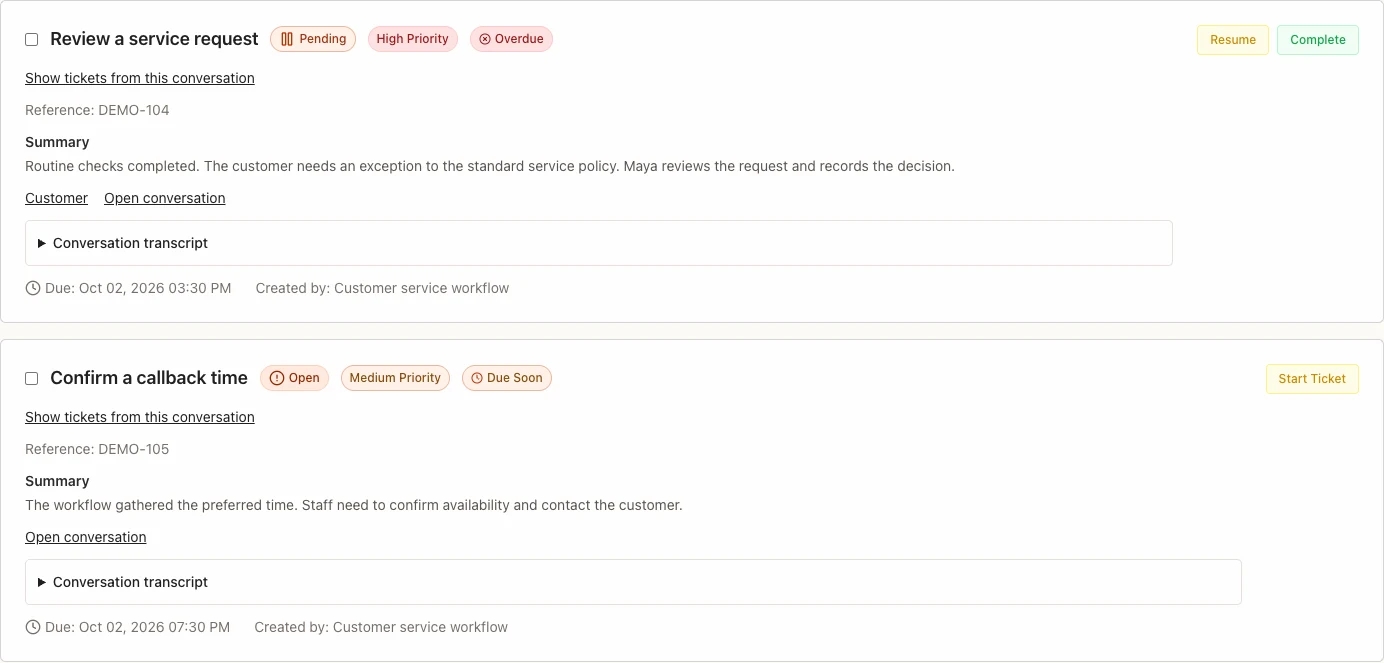
Staff review priorities, handle exceptions and decisions, and record what happened. Owners and delays stay visible.
Product snapshot · Sample data
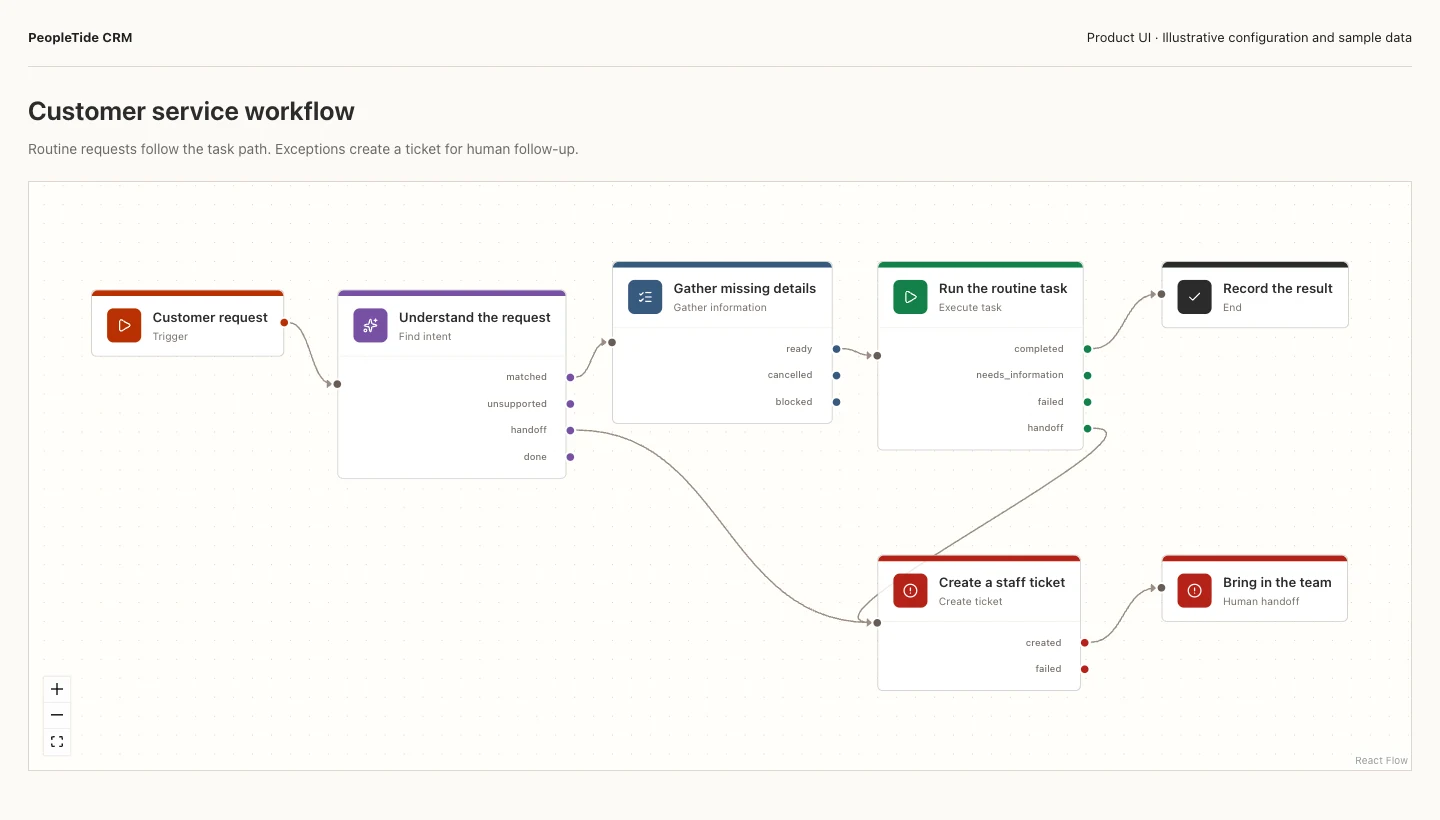
Routine task or human handoff
The workflow branches from task execution to a recorded result or a ticket for staff follow-up.
Snapshots use the CRM product interface with illustrative configuration and sample data. Tasks, routing and connections require setup. Automation does not replace staff decisions or establish a guaranteed efficiency improvement.
From a request to a responsible action
Context. Ownership. Follow-through.
01
Understand the request
Start with the request and relevant records from a configured connection.
02
Automate routine steps
Use that context to carry out defined steps within the permissions granted.
03
Involve your team
Bring in a person when an action needs approval or a request needs judgment.
04
Confirm the result
Check what changed in the responsible application and keep the next owner clear.
The customer journey, supported by better operations
Less chasing. More follow-through.
When context, ownership and the next action stay connected, your team can spend less time coordinating work and give customers a clearer answer.
01
Attract
Bring relevant enquiries into view.
Marketing campaign delivery and connected attribution are still being developed.
02
Respond
Use customer context and assign the next action.
CRM conversations and follow-ups depend on channel setup.
03
Convert
Confirm the booking or record the next sales step.
Scheduling supports bookings. General purchase and order connections are planned.
04
Deliver
See pending work, resolve delays, and record what happened.
CRM tasks support follow-through. Healthcare queues are in the HMIS pilot; general fulfilment connections are planned.
05
Bring customers back
Follow up on the experience and the next customer need.
Configured CRM follow-up is available; complete retention and revenue reporting is still being developed.
Illustrative example
Service business
From an enquiry to a confirmed booking and a completed follow-up.
01
Capture the enquiry
Keep the customer’s request and available history together.
02
Make the booking
Offer a supported booking link. Keep a pending confirmation assigned to an owner.
03
Spot the delay
An overdue follow-up stays visible with its owner, priority and due time.
04
Follow through
The teammate reviews the context, contacts the customer and records the result.
05
Prepare the next visit
Keep the completed work in the customer history for a configured follow-up.
Illustrative example. Booking and follow-up require configuration. Marketing campaign delivery and complete repeat-customer reporting are still being developed.
Illustrative example
Retail business
From a product enquiry or support request to an answer and a recorded result.
01
Capture the request
Keep the product question or concern attached to the customer conversation.
02
Assign the work
Give the response or next sales step a clear owner and priority.
03
Spot the delay
A response waiting for a decision or a handoff stays visible to the team.
04
Give the customer an answer
The responsible teammate handles the approval and records what was agreed.
05
Record the result
Keep the support outcome and next follow-up attached to the customer record.
Illustrative example. General order, payment and fulfilment connections are planned. Purchases, delivery completion and repeat sales need evidence from the systems that manage them.
Connected records
Keep records in the app that manages them.
Each application remains responsible for its records and business rules. A supported connection preserves the source and access scope of the information it uses.
Human responsibility
Make the next decision clear.
If an action needs approval or its result cannot be confirmed, keep the reason, available evidence and next owner visible. Sending a message or creating a task does not mean the customer’s request is resolved.
From efficient work to a measurable result
See the work. Check the outcome.
Find delays first. Then check the customer experience and the business result using evidence from the responsible system.
Operational efficiency
Overdue tasks, time waiting, handoff delays, completion time
Understand where work needs attention. Current task views show owners, due dates and status; complete account-wide timing reports are proposed.
Customer experience
Response time, resolution time, recorded feedback
Check what the customer experienced. A completed task alone does not establish satisfaction; consolidated reporting needs verified timing and feedback records.
Check the result in the responsible system. A confirmed booking does not establish additional revenue; purchase and repeat-customer reporting need further connections.
Organise the work
Find and resolve delays
Serve customers better
Achieve measurable outcomes
These are measurement goals, not promised improvements or a live account-wide dashboard. Availability depends on the app, configuration and source evidence.
Start with one workflow
Improve how work moves. Agree what success looks like.
Identify the delays, the people responsible and the result you want to measure. We’re exploring a base subscription for ongoing operational value, plus agreed, verified outcomes.
Proposed pilot model. No fixed rates or guaranteed improvements. Capabilities depend on the app and configuration; the shared platform is not yet offered as a standalone service. Third-party integrations: planned support